

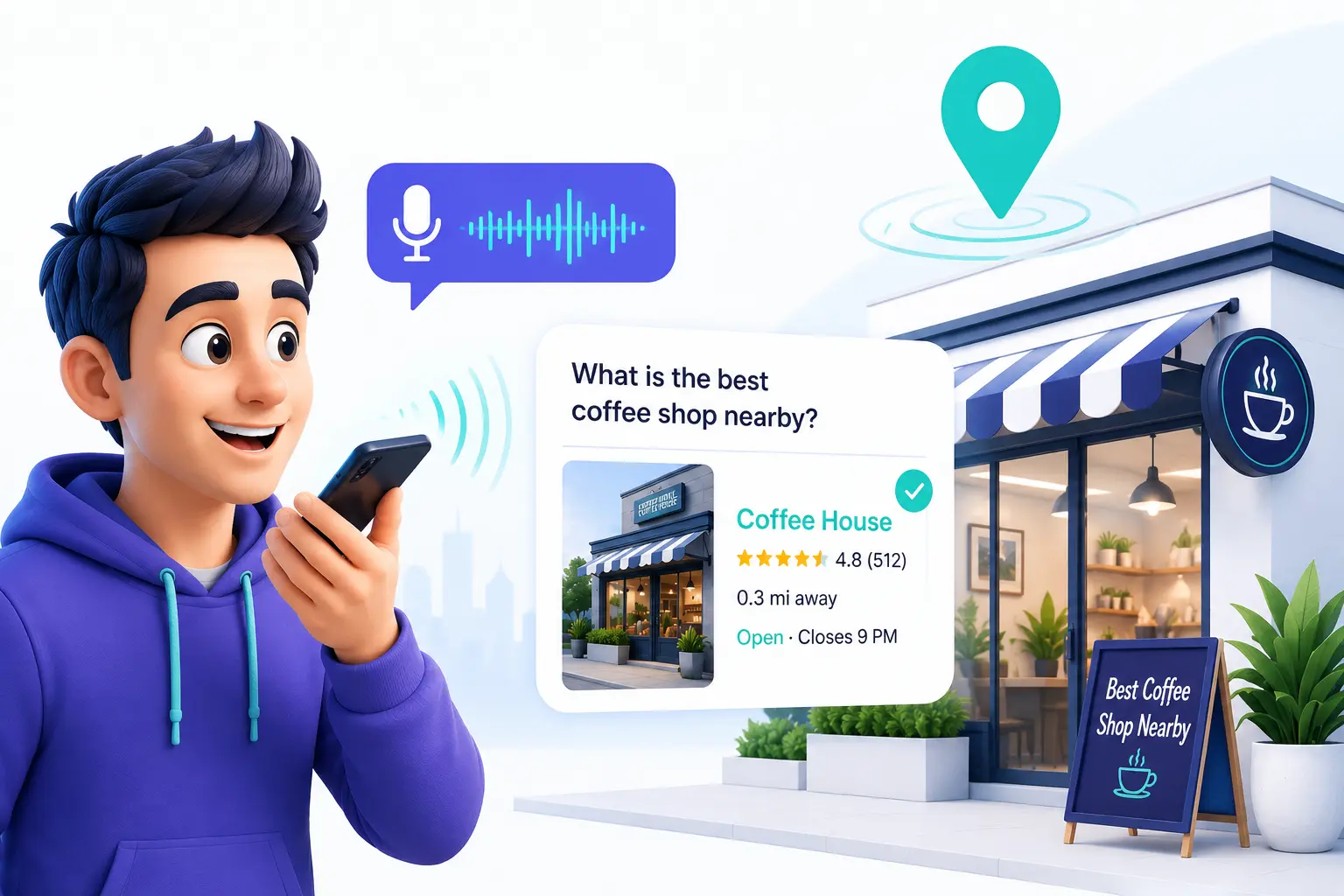
Consider this typical scenario, a driver locks their keys in their car at 10 PM outside a Tampa restaurant. They don’t need to panic; help is at hand! They don’t need to open a browser or even type in a search query. They simply say, “Hey Siri, find me a locksmith near me, that’s open right now.”
In the blink of an eye, Siri delivers two business names. The driver calls the first service and the search is over in seconds.
This process is becoming an increasingly common way people can quickly reach local businesses or service providers. Voice assistants like Siri, are now built into the latest smartphones, vehicles, smart speakers, and wearable devices. For users, the convenience is indisputable when you consider that a voice search is often faster even, than typing. For local businesses, it is changing how customers discover and choose their service providers.
An important distinction that makes voice searches fundamentally different from, say, an online Google search, is that users are rarely given a page of results. Instead, they expect a direct answer or maybe a few trustworthy recommendations. As AI-powered assistants become more capable, they are increasingly selecting, summarizing, and presenting the best choices, on the user’s behalf.
That shift from displaying a list of options to recommending specific businesses is changing the way local visibility is earned. Voice assistants and AI driven platforms increasingly rely on business data, reviews, citations, websites, and other trust signals when deciding which businesses to recommend. For many organisations, these are the same foundations that support a strong local SEO strategy. This article explores how voice search is changing local discovery and how businesses can adapt.
What Voice Search Actually Is (and is not)
A voice search is any search initiated through a speech command rather than via text input. In effect, this covers the use of a wide and growing range of tools: asking Siri for directions while driving, querying Alexa for a plumber while doing dishes, speaking to ChatGPT Voice or Gemini Live to compare local trades or services, or using an AI assistant embedded in a car, smart TV, or wearable device.
However, what voice search is not, is just a spoken version of a Google query. The difference between these two processes is not limited to how the query is made. It extends to what happens in response to the query.
We all understand that a typed search usually returns a list of options, often ranked with the “best” answer listed highest, or first. The user then decides which response to click on. A voice search, however, often returns a direct answer, with one or more recommendations in a much smaller set of choices. So, the AI tool plays a much larger role in deciding what information gets selected to present as your result. This distinction is more significant than it first appears. Traditional search mechanisms shifted power toward platforms over publishers. While a voice search shifts more decision making from the users themselves to the AI system being used, and those systems operate very differently from the traditional ranked results page.
Understanding the Voice Search Landscape
We need to understand that the various voice search vehicles don’t operate on a single channel. So, the different voice assistants don’t evaluate businesses in the same way. The source data, ranking algorithms, and recommendation logic vary from platform to platform. Let’s consider:
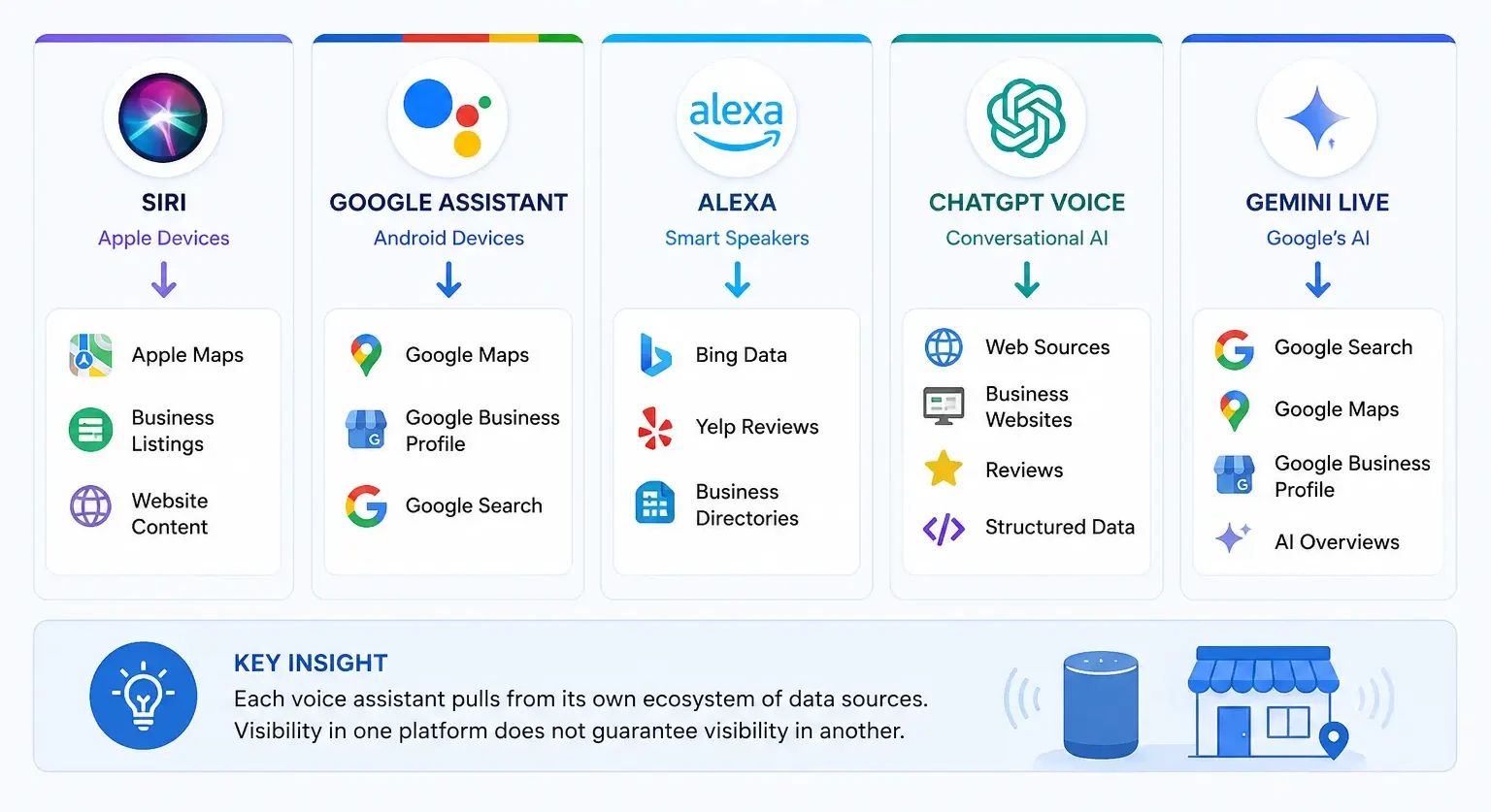
- Google Assistant and AI Overviews: are the dominant voice search channel for Android users and Google Search. Closely integrated with Google Maps and Google Business Profiles.
- Siri: Available across Apple’s universe of electronic devices. Relies heavily on Apple Maps, business listings, and web content rather than Google’s search index.
- Alexa: Widely used through smart speakers and connected home devices. Draws significantly from Bing and Yelp data.
- ChatGPT Voice: Growing rapidly among users who prefer conversational research. Can combine trained knowledge with live web information when available.
- Gemini Live: Google’s conversational AI experience that is gradually replacing traditional Google Assistant functionality, and is intricately connected to Google’s search and maps ecosystem.
- Perplexity: An emerging AI search platform that provides cited, multi-source answers, and is rapidly becoming a popular research tool.
This multiplicity in systems is a trend worth understanding. In the early evolution of voice search tools, Google Assistant dominated the landscape and the different models were often treated as interchangeable. However, that almost standardized structure has come to an end. Local businesses are now being evaluated by multiple AI systems, each operating on different datasets, different retrieval methods, and a variety of recommendation frameworks. From the emergence of this profound shift, we must accept that your visibility on one platform no longer guarantees visibility on any others.
How Voice Search Differs from Traditional Search
Understanding these differences is essential for your success, because the voice search tool is not simply another way to access traditional search results. Instead, it changes how users ask questions, how platforms evaluate answers, and how businesses can generate visibility.
The differences between typed requests and spoken search commands are not superficial. They reflect fundamentally different user behaviors, expectations, and commercial dynamics.
Language: Conversational Rather Than Fragmented
When we used typed searches, they tended to be compressed commands. They stripped out grammar, drop pronouns, and omit context that users assume a search engine can deal with. However, voice searches rarely work with these constraints.
Typed query: locksmith Tampa FL
Spoken request: “Who is the best locksmith near me, open right now?”
This is not just a longer sentence. It is a query framed as a conversation. It sounds like a question directed at a person because the users are psychologically imagining they are addressing a respondent, rather than simply operating a retrieval system. The implications we can draw from this are the way our site’s content has to be written and structured, and this is significant.
Intent: More Specific, More Actionable
These days, voice queries are often posed with a higher degree of specific detail. By the time many users perform a local voice search, they are already close to making a decision. The nature of the query itself often reflects this.
Voice searches are more likely to include qualifiers related to timing, availability, proximity, and service type, which better determines the results the user will get. A business that can only be identified as “a locksmith in Tampa,” may not be recommended for a more specific query such as “a locksmith in Tampa open after 9 PM on weekends.”
This distinction matters considerably, because voice assistants are normally trying to satisfy an immediate and specific need, rather than simply support broad research.
Results: One Answer Rather Than Ten Options
This is the most commercially significant difference, one recommendation or maybe two. Rather than a spray gun effect with a ranked list that you have to work your way through.
Traditional search engines typically present multiple results that may or may not closely match the query, and leave users to compare options. Voice assistants and AI platforms, on the other hand, often provide a single recommendation or a very short list of choices.
Where you get a traditional search page result, with maybe ten listings on the first page, businesses appearing in third or fifth position can still attract clicks and enquiries. By contrast, with a voice recommendation result, businesses named first are likely to receive significantly more attention than businesses mentioned later, while businesses that are not mentioned will receive none at all.
This is how visibility is becoming increasingly binary; in a way it never was during the era of traditional search results pages.
Why Voice Search Matters for Local SEO in 2026
The numbers are no longer in question. According to SQ Magazine, more than 20% of the global population now uses voice search in some form, while billions of voice assistants are active across smartphones, vehicles, smart speakers, wearables, and other connected devices. Voice search is no longer an emerging tool. It is an established part of how people find information and locate local businesses. What matters now, is understanding what happens after the query is voiced.
When someone asks ChatGPT, Gemini, Siri, or another AI powered assistant for a local recommendation, the system is often expected to do more than just retrieve information. It must rapidly evaluate options and present an answer, recommendation, or shortlist of businesses or providers that satisfy the user’s expectations.
To achieve that, AI systems draw signals from multiple sources simultaneously. These could include Google Business Profiles, websites, reviews, business directories, mapping platforms, and available structured data. When those sources reinforce one another, confidence in a specific business entity increases. When information is incomplete, inconsistent, or contradictory, confidence can decrease. Strong authority signals, including local backlinks, citations, reviews, and business mentions, can help reinforce that trust across multiple platforms.
The same mechanism applies to the intention of ‘local’ or ‘near me’. A query such as “locksmith near me” is no longer evaluated by proximity alone. Modern AI systems also consider factors like business hours, availability, relevance, reputation, level of authority, and the consistency of information about the options presented, across multiple sources.
These major determinants explain why the stakes have shifted. Voice initiated local searches are often made with high intent. A person looking for a locksmith tonight or a plumber today is usually much closer to taking action than someone conducting general research. Research highlighted by Marketing LTB’s voice search statistics suggests that many local voice searches result in users taking action shortly after making the query.
For businesses that appear in the generated recommendations, the opportunity it brings can be significant because the user is already searching with a clear purpose. For businesses that don’t appear, the challenge extends beyond traditional rankings. Increasingly, visibility depends on how trustworthy, competent, and consistent a business appears across all the sources AI systems rely upon to make their informed recommendations.
In the new electronic world order, local SEO is no longer just a ranking exercise. It is a credibility exercise, and results or recommendations are highly competitive.
The Future of Voice Search
Several trajectories in this arena are already visible enough to assess with confidence.
Predictive search
AI systems are beginning to anticipate the user’s needs before they are explicitly expressed, offering recommendations based on location, time, context, and past behavior. Discovery may increasingly happen before a traditional search query is even formed.
On device AI
Apple Intelligence and similar systems are handling a growing share of interactions using Apple Maps, local data sources, and on device processing rather than relying exclusively on traditional search indexes. The visibility of businesses across platforms such as Apple Maps, Bing, and Yelp is becoming increasingly important.
Real time accuracy
AI systems are incorporating live business information into recommendations, including hours, availability, and operational status. As a result, operational accuracy is becoming a competitive signal rather than a simple maintenance task.
Voice commerce
Voice as a purchase completion interface has been underdelivered relative to early expectations. The more realistic opportunity is to consider voice as a transaction initiator: booking appointments, requesting quotes, scheduling services, sourcing best options and making first contact. That arena is already real, and it continues to grow.
Voice dissolves into intent
“Voice search” as a distinct system may prove temporary. The underlying shift is toward intent based local discovery, where the method of input matters less than whether an AI system can confidently identify and recommend a suitable business in response to the user’s query.
Conclusion
The advances represented by the voice search tool, is not really about voice. It is about the transition from search engines that present a list of options to AI systems that increasingly make informed recommendations. Voice is simply where that transaction becomes most visible, and where its commercial consequences are easiest to observe.
For local businesses, the question has changed from “How do I rank?” to “How do I become the business an AI platform trusts enough to recommend?”
They are not the same questions.
The gap between them is arrived at through consistent information, accurate business data, credible reviews, and a digital presence coherent enough for machines to interpret all the intertwined parameters with confidence. As AI driven discoveries continue to evolve, that gap is where the local visibility of business establishments will increasingly be won or lost.