

Business owners are beginning to realize that potential customers in their local area are no longer just searching in Google. These days, people can discover the services and businesses they need through a much wider landscape of search engines, AI platforms, and other platforms like Google Maps. If your business can only be reached in one of these places, it’s possible that only some of your potential customers are finding you
A few years ago, ranking well in a Google search was often enough to generate good enquiries in your local area. Today, however, customers have a number of more sophisticated tools at their disposal, to research and compare businesses in their area.
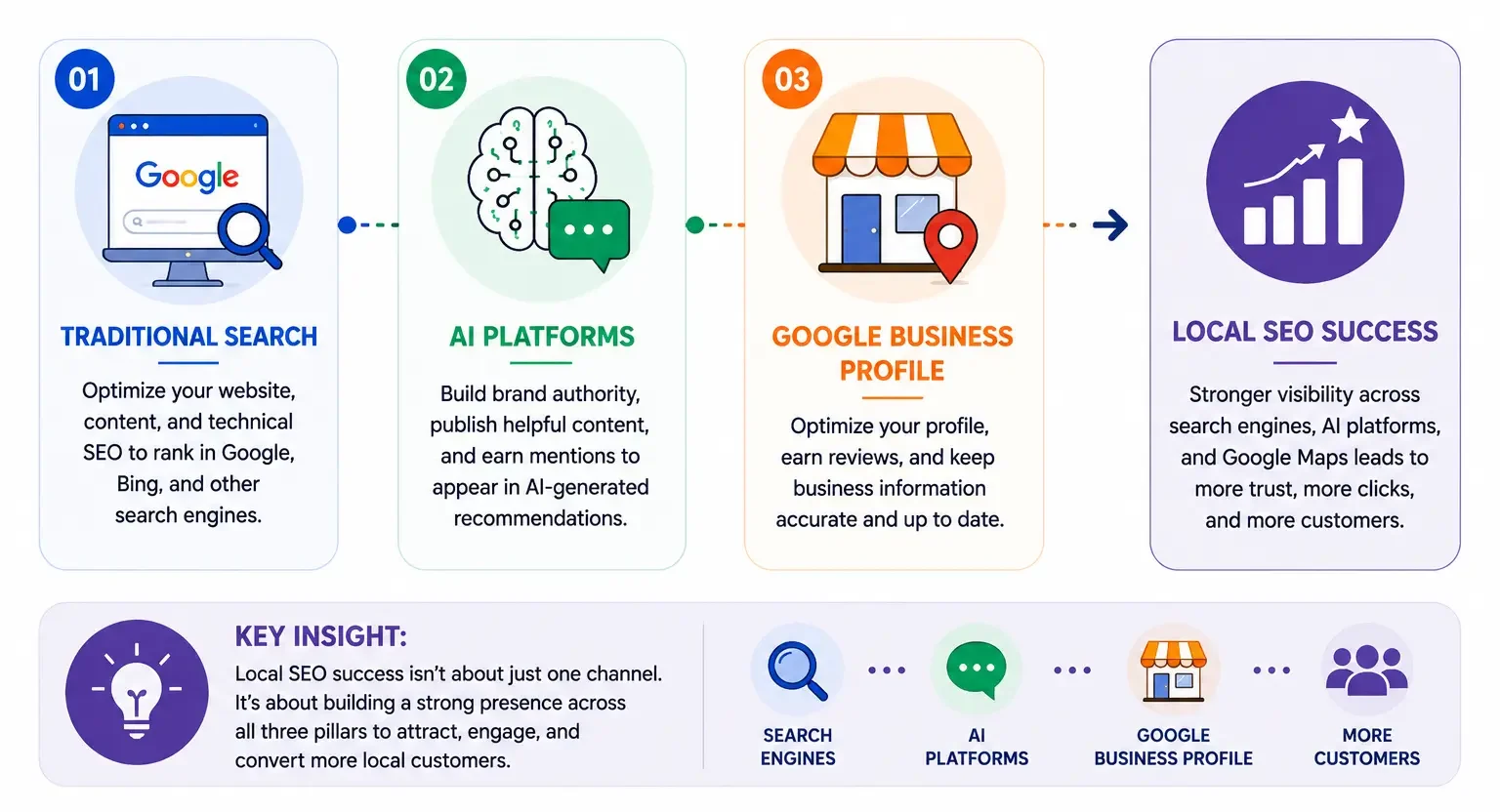
Most searches for local services are now conducted through any of three channels:
- Traditional search engines, which include Google, Bing, and DuckDuckGo
- AI platforms such as ChatGPT, Gemini, Claude, and other large language models
- Google Maps, and the Local Map Pack
Because each channel works differently, the most effective SEO strategy is no longer simply about ranking in a single place. Businesses that want to improve visibility across search engines, AI platforms, and Google Maps often benefit from a comprehensive local SEO strategy designed around all three channels.
In this guide, you’ll learn how to build a local SEO strategy from the ground up, and create a wider presence across today’s most popular search platforms.
1. Strategies for Traditional Search Engines
Results show that traditional search engines are still the cornerstone of any local SEO strategy. For your business to attract the greatest possible traffic, you need to build a strong organic presence. To generate the widest reach you can, focus on these four pillars:
1.1 Website Optimization
In today’s online commercial climate, your website represents your digital storefront, and it needs to prominently address the services, locations, and questions your customers are searching for. A tactically planned and well-organized website helps ensure that search engines understand what you have to offer, and this improves your chances of ranking high for relevant local searches.
Key principles for the best website optimization in your local area include:
- Create dedicated service pages for each service you offer
- Build location pages for the areas or locations where you want to rank well
- Publish useful blog content that targets the questions, problems, and topics your local customers will use in their search
- Create a dedicated FAQ page that answers common customer questions, which will capture question-based search traffic
- Organize your website so your service pages, location pages, blog content, and FAQ pages support one another through a logical site navigation design
1.2 Technical SEO
It is important to understand that without a solid technical foundation, even exceptional website content can struggle to rank well. Proven technical SEO strategies help search engines crawl, index, and understand the relevance and authority of your website.
For the beginner, you need to focus first on site speed, its mobile usability, and the internal linking. Once those fundamentals are established, you can strengthen your technical foundation with the following:
Key technical SEO elements to address:
- Core Web Vitals and page speed
- Mobile usability and responsive design
- Internal linking structure
- Schema markup, particularly LocalBusiness schema
- XML sitemaps and robots.txt configuration
- Identifying and correcting crawling and indexing issues
- Broken links, 4XX errors, and any redirect issues
1.3 Backlink Strategy
While this is a widely misunderstood area, backlinks still remain one of the most effective ranking factors for influencing traditional search engines. Understanding which local backlinks still carry value can help you build authority more effectively. If your site can establish a strong backlink profile, it signals that you have authority and trustworthiness. Here’s a hack that generally works. A proven effective way to identify link opportunities for your site, is by analyzing what is already working for your most successful competitors.
How to build an effective local backlink strategy:
- Analyze your top competitors’ backlink profiles using tools such as Ahrefs or Semrush
- Identify the types of websites linking to them, including local directories, relevant industry publications, and local news outlets
- Gather mentions from local business associations, chambers of commerce, and community organizations
- Pursue guest posting opportunities on relevant industry blogs and local websites
- Create useful resources such as local guides, relevant case studies, and original research that naturally attract links
1.4 Social Media Presence
While higher website rankings are driven primarily by your website structure and content, good technical SEO, and plenty of backlinks, a consistent social media presence helps strengthen your overall online visibility. This results in greater organic promotion of your business entity and what you have to offer.
Best practices for social media presence:
- Focus on platforms where your local audience is most active. Sites like Facebook, Instagram, YouTube, and LinkedIn are strong starting points
- Post helpful content regularly to maintain an active and trustworthy presence
- Respond promptly to comments and messages to build engagement and trust
- Share locally relevant content such as community news, local events, customer stories, and interesting behind the scenes updates
⏱ Reality Check: Organic SEO Takes Time
Despite your enthusiasm to get started and pump out encouraging results right away, new websites typically need three to six months to build meaningful authority and begin ranking competitively. So, focus on regularly creating valuable content, earning quality backlinks, and consistently improving how your website presents. Sustainable rankings are built over time, rather than overnight.
2. Strategies for AI Platforms and LLMs
In today’s rapidly morphing online landscape, search behaviour is evolving all the time. Web users are becoming more sophisticated and tech savvy. A growing number of users now utilize AI platforms for local recommendations, product comparisons, and buying advice instead of relying solely on traditional search engines. Recent industry analysis estimates that AI assistants now generate approximately 45 billion monthly sessions worldwide, demonstrating how quickly search behavior is evolving beyond traditional search engines.
The challenge is that these AI platforms don’t disclose the exact parameters they measure to determine which businesses appear where, in AI generated responses. However, by studying businesses that are frequently ranked well, you can identify several consistent patterns.
Unlike traditional search engines that will display hundreds of results, AI platforms often recommend only a handful of businesses. This makes visibility more competitive, but also more valuable for those businesses that are able to earn greater trust and strong recognition across the web.
To improve your chances of appearing in AI generated recommendations, you need to focus on building your authority, and increasing your visibility across the platforms, websites, online communities, and publications that AI systems frequently reference.
2.1 Authority Signals
Modern AI systems logically favor businesses that demonstrate strong authority and credibility, across multiple sources. Therefore, the stronger you can build your authority, the more likely AI platforms will recognize this and reference your business.
Authority signals tend to include:
- High quality backlinks from reputable and relevant websites
- Strong performance in traditional local SEO
- Positive customer reviews across multiple platforms
- Mentions from trusted industry publications, online communities and websites
- Demonstrated expertise through helpful content and resources
- Regular posting of interesting and relevant content
2.2 Popularity Signals
AI systems have access to a wide range of online sources, including forums, review platforms, news websites, blogs, and social media. Therefore, businesses that are frequently discussed and recommended across these sources will build the stronger popularity signals and stand out.
Popularity signals tend to include:
- Discussions on Reddit, Quora, and niche industry forums
- Social media engagement and brand mentions
- Coverage in local news outlets and industry publications
- Inclusion in “Best Of” lists, comparison articles, and buying guides
- Customer generated content, testimonials, and case studies
⚠️ Reality Check: AI Rankings Are Not Transparent
No one outside these AI companies know exactly how ChatGPT, Gemini, Claude, or other LLMs decide which businesses they will recommend. Their algorithms are not publicly disclosed and of course, continue to evolve organically. However, businesses who have built strong authority, plenty of positive reviews, good quality backlinks, and widespread positive online mentions consistently seem to be cited more often.
3. Strategies for a Google Business Profile
A Google Business Profile is the foundation for achieving Google Maps visibility. Since the Map Pack frequently appears above traditional organic results, optimizing your profile is essential for attracting local customers who are actively looking for your type of services.
Businesses that consistently appear in the Map Pack can receive highly targeted traffic from customers who are ready to take action. There are tried and tested steps to optimize your business profile for better local visibility.
3.1 Business Name
Logically, your business name is a primary signal that Google uses to identify and understand your business. Consistency across your Google Business Profile, your website, any social media profiles, and your directory listings helps strengthen recognition. This consistency makes it easier for Google to gather information about you, from all the potential different sources.
Best practices for your business name:
- Use your actual business name exactly as it appears in the real world
- Keep your business name consistent across your website, social media profiles, and directory listings
- Ensure that your branding, signage, and online presence all use the same business name
- Follow Google’s business name guidelines to avoid edits, suspensions, or verification issues
3.2 Address
The location you use for your Google Business Profile will influence the areas where your business is made most visible, in Google Maps. For many local businesses, visibility is strongest near their registered location and gradually decreases as the distance away increases.
Best practices for your address:
- If you operate a physical, or bricks and mortar business, choose a location close to the customers and communities you want to serve
- Use your actual business address and ensure it accurately reflects where your business operates
- If you operate as a service area business, define only the suburbs and locations you genuinely serve
- Ensure your address and service area information is consistent across your Google Business Profile, website, and all other business listings
- Avoid virtual offices, PO boxes, and other locations that do not represent a legitimate business presence
Businesses that accurately represent their location and area of service coverage, are more likely to build long term visibility and avoid Google Business Profile compliance issues.
3.3 Categories
Selecting the correct primary category is one of the most impactful optimizations you can make when building your Google Business Profile. Your primary category tells Google what your business does and directly influences which searches might trigger your listing for referencing.
Best practices for categories:
- Search your preferred main keywords on Google Maps and check which primary category your top-ranking competitors use
- Choose the most specific category that accurately represents your core service
- Add relevant secondary categories to expand visibility for related searches
- It is important to avoid categories that do not genuinely reflect your services
- Review your categories periodically, as Google regularly adds new options
3.4 Reviews
Reviews are among the strongest ranking factors available. Businesses with a steady flow of genuine customer reviews often outperform competitors in Google Maps.
Best practices for building reviews:
- Ask satisfied customers to leave a review immediately after a positive experience
- Make it easy by sharing a direct link to your Google review page
- Respond to every review, both positive and negative, promptly and professionally
- Never incentivize, purchase, or fabricate reviews
The quantity of reviews, their quality, their recency, and your response activity all contribute to a stronger local ranking profile.
3.5 Google Posts
Google Posts allow you to share the latest updates, offers, events, and announcements directly on your Business Profile. While posts are not considered a major direct ranking factor, they help demonstrate that your profile is active, up-to-date, and well maintained.
Best practices for Google Posts:
- Publish at least two to four relevant posts per month to keep your profile active
- Use offer posts to promote seasonal promotions and special deals
- Use event posts for workshops, open days, and community activities
- Make sure you include a clear call to action in every post
- Add a relevant, interesting image to every post
- Keep the content concise, informative, and focused on local customers
3.6 Citations
Citations are mentions of your business name, address, and phone number across directories, review platforms, and other local websites. Consistent citations help Google verify your business, establish your authority and strengthen local trust signals.
To build a strong citation profile:
- Submit your business to major directories such as Google, Yelp, Bing Places, and Apple Maps
- List your business in the relevant industry specific directories
- Ensure your business information is consistent across every platform
- Audit and correct inaccurate or duplicate listings
📍 Reality Check: No Single Factor Guarantees Top Rankings
Local rankings in Google Maps are determined by a combination of relevance, proximity, trust, and prominence. You need to emulate businesses that perform consistently well by providing accurate information, earning strong reviews, selecting relevant categories, building quality citations, and having an active online presence. Long term consistency nearly always wins in local search results.
Local SEO Strategy Summary
The table below summarizes the three primary channels and their key focus areas:
| Channel | Main Goal | Key Factors |
| Traditional Search Engines | Organic Rankings | Website Structure, Technical SEO, Content, Backlinks |
| AI Platforms (LLMs) | AI Recommendations | Authority, Popularity, Online Mentions |
| Google Business Profile | Map Pack Rankings | Categories, Reviews, Citations, Location Signals |
Each channel serves a different purpose, but success in one can often strengthen your performance in the others. Strong authority can improve both organic rankings and AI visibility. Positive reviews can influence both Google Maps visibility and AI recommendations. The most successful local businesses develop a strategy that supports all three channels simultaneously.
Conclusion
Building a local SEO strategy today, is a very different process from what it was just a few years ago. Astute businesses are no longer competing for visibility simply on Google alone. Customers are now discovering local businesses through a cocktail of traditional search engines, AI platforms, Google Maps, review websites, online communities, and many other digital touchpoints.
While the platforms may differ, their goal remains the same. Search engines, AI platforms, and Google Maps all aim to recommend businesses that have built trust. The more visible, credible, and authoritative your business becomes online, the greater the likelihood that your site will appear wherever potential customers are searching.
Businesses that consistently succeed in local area searches, focus on the fundamentals. They build useful websites, earn quality reviews, acquire relevant backlinks, create valuable content, and maintain a lively and trustworthy online presence. These basics strengthen their visibility across traditional search engines, AI platforms, and Google Maps at the same time.
Building local SEO for your site is not a onetime project. It is an ongoing process of generating trust, authority, and visibility within your market. Businesses that invest consistently in these crucial areas are much more likely to generate sustainable rankings, qualified leads, and long-term growth.
🚀 Where to Start
If you’re building a local SEO strategy from scratch, start by creating and optimizing your Google Business Profile. Next, build a website with dedicated goods or service pages, location pages, blog content, and FAQ content. Once those foundations are in place, focus on earning reviews, building citations, and acquiring quality backlinks.
As your presence grows, you’ll strengthen your visibility across the traditional search engines, AI platforms, and Google Maps, helping your business attract customers wherever they choose to search.